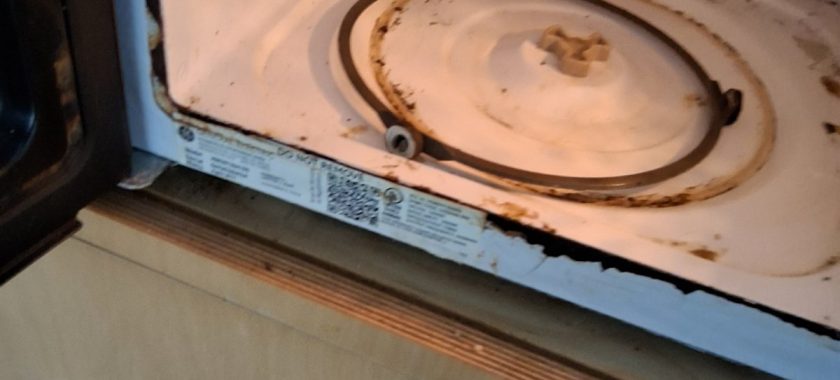
Most of us don’t give the rhythmic, slow-motion carousel inside our microwaves a second thought—until it stops. You press start, the light kicks on, the hum begins, but the glass tray remains stubbornly still. While it might seem like a minor mechanical hiccup, a microwave plate that fails to spin is more than just a nuisance; it is a fundamental breakdown in the appliance’s ability to cook food safely and effectively.
To understand why this matters, we have to look at the physics of how a microwave actually works.
The Physics of Hot and Cold Spots
Microwaves do not heat food from the outside in like a conventional oven. Instead, they use a magnetron to send electromagnetic waves bouncing around the metal interior. These waves excite water molecules in your food, causing them to vibrate rapidly and generate heat through friction.
However, these waves aren’t distributed perfectly. They form a pattern of “standing waves,” creating specific areas of high intensity (nodes) and areas of almost no energy (antinodes). If your food remains stationary, it sits in a fixed position relative to these waves. The result? One section of your lasagna might reach boiling temperatures while another remains literal ice.
The spinning turntable was engineered specifically to solve this problem. By rotating the food through the field of electromagnetic energy, the microwave ensures that every part of the dish passes through the “hot spots,” leading to an even distribution of thermal energy.
What a Non-Spinning Plate Means for Heating Performance
When the rotation stops, the quality of your food—and potentially your health—is compromised. Here are the primary consequences of a stalled turntable:
1. Uneven Thermal Distribution
This is the most immediate effect. Without rotation, the microwave’s energy is concentrated on specific “strike points.” This often leads to “leathery” textures in breads or proteins that are overcooked in one corner and raw in the center. The lack of movement prevents the conductive heat transfer that usually helps balance out the temperature during the cooking cycle.
2. Food Safety Risks
Uneven heating isn’t just about taste; it’s about safety. For leftovers or raw proteins, reaching a consistent internal temperature is vital to killing bacteria. A stationary plate can leave “cold pockets” where bacteria can survive, even if the rest of the dish is steaming hot. This is particularly dangerous when reheating soups, stews, or meat products.
3. Increased Arcing and Damage
In some cases, if energy is constantly hitting the same spot on a dish or the interior floor because the load isn’t moving, it can lead to “arcing” or localized overheating of the microwave components. Over time, this can damage the interior cavity coating or strain the magnetron, leading to a much more expensive repair than a simple motor replacement.
Why Is It Not Spinning?
Before you assume the worst, there are several common culprits behind a stalled plate:
- Obstructions: Often, food debris or a misaligned roller ring is the culprit. Even a small crumb can jam the wheels of the support ring.
- The Drive Bushing/Coupler: The plastic piece in the center that connects the motor to the glass tray can crack or strip over time, losing its grip.
- The Turntable Motor: Like any mechanical part, the small motor beneath the floor of the microwave can burn out. This is a common point of failure in units older than five years.
- Control Board Issues: Less commonly, a fault in the main electronic control board may fail to send the signal to the motor to begin operation.
Restoring the Rotation
While some homeowners attempt to DIY a motor replacement, microwaves contain high-voltage capacitors that can hold a lethal electrical charge even when the unit is unplugged. For the sake of safety and precision, professional intervention is always recommended.
A stationary plate is a sign that your appliance is operating at a fraction of its intended efficiency. Don’t settle for lukewarm centers and scorched edges.
If your microwave tray has stopped its rounds, it is time to call in the experts. Chula Vista Appliance Repair Company specializes in diagnosing and fixing turntable assemblies, motor failures, and magnetron issues. We ensure your kitchen remains efficient and your meals stay safe.
Contact Chula Vista Appliance Repair Company today to schedule your service and get things moving again.
Contact us
(619) 880-5508