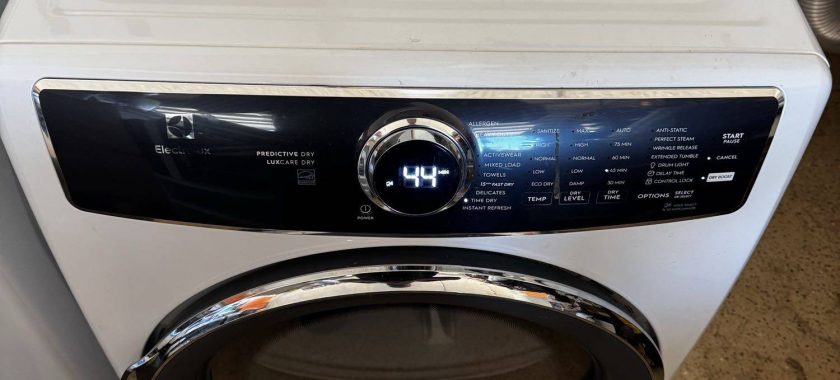
A washing machine that repeatedly fails to stabilize small loads before entering the spin cycle is usually reacting to an internal imbalance it cannot correct. Modern appliances rely on a combination of mechanical suspension and electronic sensing to distribute weight evenly. When either system becomes unreliable, the drum may pause, restart, or extend the cycle in an attempt to compensate. Over time this behavior can become more frequent and noticeably disrupt normal washing performance.
Small loads are particularly sensitive to imbalance detection. A few heavy items—such as towels, jeans, or a single dense garment—can shift unevenly inside the drum. Under normal conditions, the machine redistributes the load by rotating slowly in both directions before spinning. If this process fails repeatedly, the issue often goes beyond load composition and points to a technical fault.
One common source of the problem is the suspension system. Washing machines use shock absorbers, dampening rods, or springs to stabilize drum movement during high-speed rotation. When these components wear out, the drum moves excessively, confusing the control system. Instead of completing the spin cycle, the machine interprets the vibration as a persistent imbalance and stops to protect itself. This can be especially noticeable with small loads because there is not enough mass inside the drum to counteract the loose movement.
Another factor is the imbalance detection sensor. Many modern machines rely on accelerometers or hall-effect sensors to monitor drum motion. These sensors send real-time data to the control board, which decides whether it is safe to proceed with spinning. If the sensor is miscalibrated or beginning to fail, it may incorrectly interpret normal movement as unsafe conditions. The result is repeated spin attempts or constant cycle interruptions even when the load is properly distributed.
Control board logic can also contribute to the issue. If the software controlling the spin cycle becomes inconsistent due to electrical instability or internal faults, it may repeatedly trigger redistribution cycles. In such cases, the machine appears to “struggle” even though the mechanical parts are still functional.
User habits can amplify the problem. Washing a single heavy item or mixing very different fabric weights in small quantities creates uneven distribution that is harder for the machine to correct. While this is not a defect, it exposes weaknesses in worn suspension systems or sensitive sensors more quickly.
Diagnosing the issue begins with observing the pattern. If the machine consistently struggles only with small loads, it is worth testing a medium-sized load to see whether performance improves. If imbalance warnings persist across different load sizes, mechanical wear is more likely than user-related factors. Checking for excessive drum wobble by gently pressing on the empty drum can also reveal weakened suspension components.
Simple steps such as redistributing laundry manually, avoiding single-item washes, and ensuring the machine is level on the floor can temporarily reduce symptoms. However, these measures do not address underlying hardware degradation. Once suspension parts lose elasticity or sensors drift out of calibration, the problem tends to worsen over time.
When the washing machine repeatedly fails to stabilize loads, professional inspection becomes the most reliable solution. Technicians can test suspension components for wear, verify sensor output accuracy, and check control board signals for inconsistencies. In many cases, replacing a few mechanical parts restores normal spin behavior and prevents further strain on the motor and drum assembly.
If your washing machine continues to struggle with balancing small loads before the spin cycle, it is a sign that the internal stabilization system may need attention. For accurate diagnosis and repair, contact Chula Vista Appliance Repair Company and schedule a service visit to restore stable and efficient performance.
Contact us
(619) 880-5508